中文

From education and health care to tourism and culture, China-Africa exchanges are bringing societies closer.
By Hisham AbuBakr Metwally Mohamed
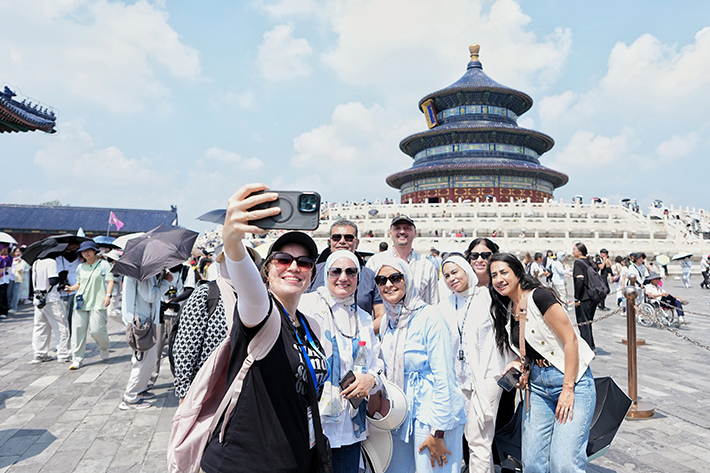
Egyptian tourists pose for a photo in front of the Hall of Prayer for Good Harvests at the Temple of Heaven in Beijing on 28 July. [Photo/Xinhua]
On 8 January, the China-Africa Year of People-to-People Exchanges was launched at the African Union headquarters in Addis Ababa, with participants calling for deeper dialogue between Chinese and African civilisations.
This launch follows a significant initiative agreed by Chinese President Xi Jinping and African leaders during the 2024 Beijing Summit of the Forum on China-Africa Cooperation (FOCAC). Themed "Consolidate All-Weather Friendship, Pursue Shared Dream of Modernisation", the initiative aims to foster exchange and mutual learning between Chinese and African civilisations, strengthen people-to-people ties, friendship and cooperation, and thereby consolidate public support for China-Africa friendship.
Throughout this process, China is guided by the principles of sincerity, real results, amity and good faith in its policy towards Africa. It will explore the potential for further cooperation across various fields, aiming to reinvigorate joint efforts to drive modernisation, contribute to building a China-Africa community with a shared future in the new era, and strive to realise the shared dream of modernisation.
Education for a shared future
China attaches great importance to educational cooperation with the African continent, recognising the vital role education plays in the advancement of nations. Consequently, China has long been committed to offering scholarships to African students, and the number of African students coming to China has risen dramatically over the past decade.
The extensive scholarship programmes offered by the Chinese government are key to attracting African students. These scholarships often cover tuition, living expenses and accommodation.
Numerous universities across China participate in scholarship programmes covering a wide range of disciplines - from medicine, engineering and agricultural technology to various other sciences and fields - at both the master's and doctoral levels. Many students have successfully secured employment in China after completing their studies, while others have ventured into business, launching their own commercial enterprises within the country. Others, meanwhile, have returned home equipped with valuable knowledge and experience that has contributed - and continues to contribute - to their nations' development and the prosperity of African peoples.
Studying abroad is not a one-way flow. As African students pursue further education in China, Chinese students are also beginning to travel to Africa to learn local languages.
Educational exchanges between China and Africa are thus moving from a predominantly one-way flow of African students to China towards greater two-way interaction in language education. This mutual learning reflects a spirit of respect that may be more meaningful than language proficiency itself.
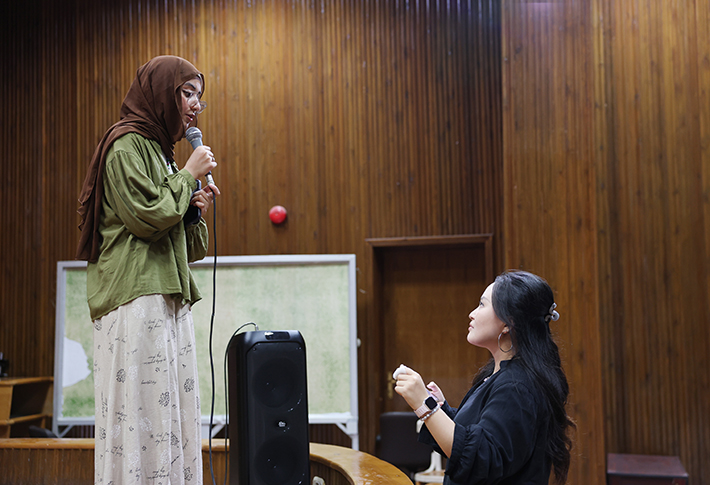
A Chinese teacher guides a student preparing for a singing competition at the Confucius Institute at Suez Canal University in Ismailia, Egypt, on 14 July. [Photo/Xinhua]
Health links
Medicine and health care are considered important areas of cooperation between China and Africa. In April 1963, a Chinese medical team of 13 members arrived in Saida, western Algeria, to assist the country, marking the beginning of Chinese medical aid to Africa. Over the past 60 years, China has sent a total of 25,000 medical team members to 48 African countries, treated about 230 million patients, and trained around 80,000 skilled medical professionals from various African countries. This has helped nurture a group of high-level doctors capable of performing surgeries independently, thereby providing local medical expertise in African countries.
During the 2024 FOCAC Summit, China expressed its readiness to work with Africa to strengthen the China-Africa partnership in health, set up a China-Africa hospital alliance, and build joint medical centres. China also announced plans to send 2,000 medical team members to Africa, carry out 20 medical and malaria control projects, and encourage Chinese companies to invest in drug production to continue providing health assistance.
During the COVID-19 pandemic, China stood firmly with the people of Africa. In November 2021, at the height of the crisis, President Xi pledged to provide 1 billion COVID-19 vaccine doses to Africa, either through direct donations or support for local production.
This demonstrated the depth of the bond between the Chinese people and the peoples of Africa during the most challenging times, proving that the vision of a China-Africa community with a shared future is not merely rhetoric, but a commitment translated into action - especially in times of crisis.
A booming tourism sector
Tourism between China and Africa has grown in recent years, with increasing numbers of travellers moving in both directions. Rising per capita income has fuelled a greater desire among Chinese citizens to travel and explore the world, with Africa emerging as a favoured destination, particularly Egypt, Morocco and Kenya, alongside other nations such as South Africa and Tanzania.
Unlike previous generations, who tended to go on group trips with set itineraries, today's young travellers increasingly prefer to travel independently and explore less conventional routes. Africa, with its distant and mysterious appeal, gives them a chance to have different experiences away from the usual destinations.
This shift is clearly visible online, where posts about "travelling to Africa" attract considerable engagement on RedNote, the Chinese lifestyle and social media platform. Some posts even draw more than a hundred comments, with users sharing information about prices and routes, and there is a growing interest in customised trips.
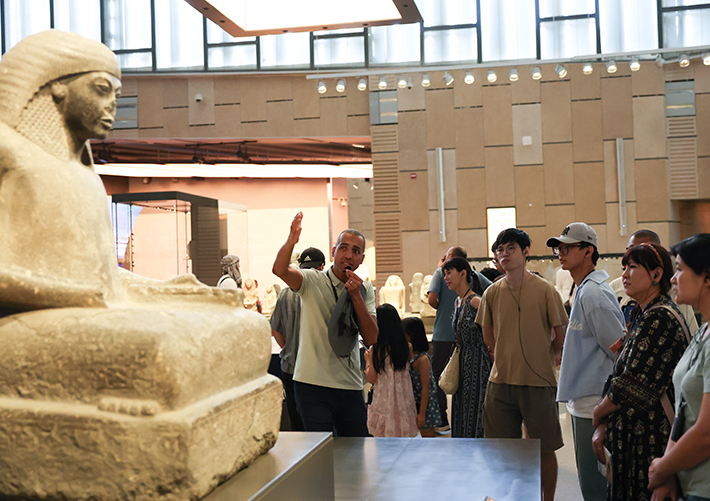
An Egyptian tour guide explains an exhibit to Chinese tourists at the Grand Egyptian Museum in Giza, Egypt, on 2 July. [Photo/Xinhua]
People-to-people exchanges
In recent years, China-Africa people-to-people exchanges have continued to expand, with increasingly active engagement in areas such as the arts, media, publishing and translation.
In the arts, joint film productions, collaborations involving African actors, directors and screenwriters, joint musical performances and literary seminars have all helped deepen cultural interaction between the two sides. The media sector has seen unprecedented engagement between China and Africa through information exchange, open discussions involving media professionals from both sides and media conferences.
In publishing and translation, there is growing interest among African readers in Chinese history and culture; the translation of Chinese books has increased, and the study of the Chinese language is expanding, with many African countries incorporating Chinese into their school curricula.
At the same time, a growing number of African works have been translated into Chinese. In 2016, Zhejiang Normal University established the Centre for African Literature Studies. Drawing on the list of Africa's 100 Best Books of the 20th Century selected by African scholars, the centre has chosen dozens of works in fields including literature, philosophy, political science, sociology, linguistics and anthropology for translation and research.
Ultimately, China-Africa relations are grounded in mutual respect, appreciation and equality - foundations that have rendered the partnership robust and enduring, allowing it to grow stronger over time.
The author is first economist researcher of the Egyptian Ministry of Foreign Trade and Industry.