中文
中文

By Warwick Powell
China's approach to relations with the United States offers a model for how major countries can coexist, and can help manage the shift toward a more multipolar world without destabilizing the global order.
The core challenge of contemporary international relations is not simply managing competition between major powers. It lies in orchestrating a peaceful transition from an era of unipolar dominance toward a genuinely multipolar international order. China's diplomatic engagement with the United States, as demonstrated during the recent bilateral summit that produced, among other outcomes, eight deliverables and understandings, reflects its sustained efforts to guide this transition without triggering global calamity.
At the heart of China's diplomatic philosophy is the vision of a community with a shared future for humanity. Far from a mere rhetorical flourish, this concept is a pragmatic operational framework for managing major-country relations in an interconnected world. The central objective of Chinese diplomacy toward the U.S. is to encourage Washington to adapt to an international environment in which major powers increasingly interact as peers, rather than within the assumptions of a predominantly unipolar order.
Washington itself frames the unfolding global order as "multipolar," but it insists on viewing this through the prism of great power competition. China's own perspective on multipolarity, both as a description of the state of the world and as a normative framework, envisions an environment in which large and small nations are treated as equals and with respect, echoing the foundational principles of the United Nations Charter.
Achieving this requires navigating a profound psychological barrier within the Western political establishment. For more than three decades after the end of the Cold War, Washington operated under the illusion of the "end of history," the belief that its political and economic model was the sole legitimate destination for all human societies. It squandered the so-called "peace dividend" by exploiting its material preponderance and, according to U.S. academics Monica Duffy Toft and Sidita Kushi in their 2023 book "Dying by the Sword," instigating an average of 3.7 new military interventions per year between 1990 and 2019, years in which its own national security was undoubtedly at its highest.
Easing an establishment out of 35 years of unipolar hubris requires delicate diplomatic skill and strategic empathy.
Here, history offers a sober warning. After World War I, the victors imposed the punitive Treaty of Versailles on a defeated Germany, inflicting economic ruin and psychological humiliation. As John Maynard Keynes presciently argued at the time, backing a major power into a corner and denying it a viable economic path creates an explosive recipe for future systemic violence.
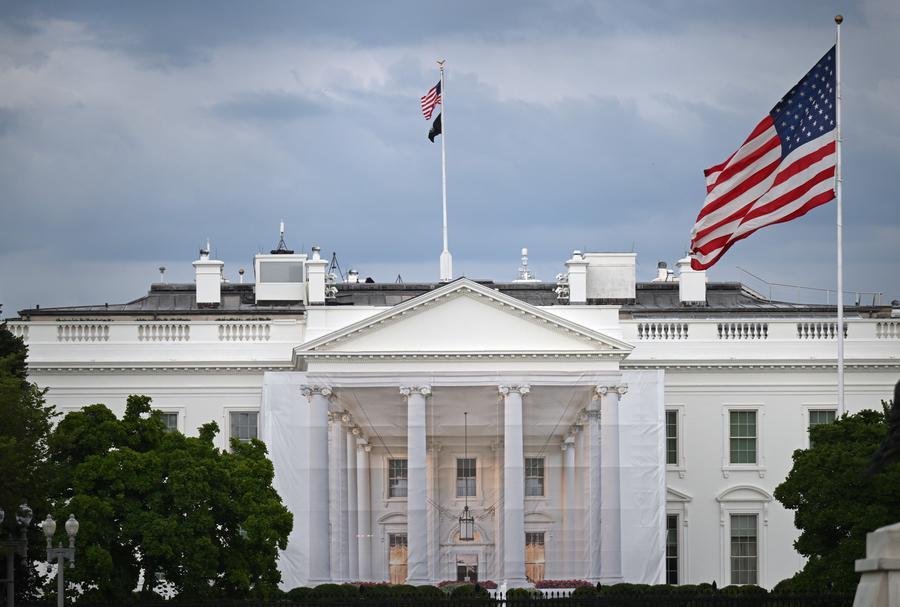
This photo taken on Aug. 17, 2026 shows the White House in Washington, D.C., the United States. [Photo by Li Rui/Xinhua]
Recognizing that a humiliated major power is a dangerous one, China seeks to avoid a "Versailles trap" by advancing a vision in which its own development need not come at the expense of American standing, but can instead create space for coexistence, mutual adjustment, and shared benefit. President Xi Jinping reiterated in Washington during his recent state visit that achieving the great rejuvenation of the Chinese nation and making America great again can go hand in hand. This proposal is rooted in his vision of building a community with a shared future for humanity. During the visit, Xi also told his counterpart that China and the United States must hold the line of no conflict and no confrontation between them, and the two nations can certainly find the right path for them to get along on this planet. In particular, he highlighted that the Thucydides Trap can be overcome, and the two great countries stand to gain from cooperation.
However, persuading an accustomed hegemon to act as an equal peer cannot be accomplished through words alone, particularly amid a febrile political atmosphere inside Washington's Beltway, where China hawks dominate public discourse. It requires creating a structural and institutional environment that nudges the U.S. toward pragmatic coexistence and, in the process, creates the diplomatic space to preserve national reputations.
When Washington attempted to enforce unilateral sanctions and trade restrictions, the limits of its leverage became immediately apparent. Global trade flows, supply chain realities and non-aligned international sentiment demonstrated that unilateral directives no longer carry their former authority. Beijing's measured response, which included extending trade truces, agreeing to military and diplomatic notification hotlines and maintaining diplomatic composure, showed Washington that constructive dialogue yields far better outcomes than coercive pressure.
It's also a model of conduct that shows the rest of the world, particularly the Global South, that China is willing to act in ways that reflect Beijing's appreciation that great nations carry a large responsibility to their own people as well as to the world at large.
By establishing bilateral channels and participating in multilateral dialogues, China provides Washington with dignified off-ramps from conflict. The agreement to establish communication hotlines and mechanisms for managing trade and investment disputes, while lacking detailed operational provisions at present, serves a critical function: It institutionalizes crisis management and lowers the risk of accidental escalation during a period of geopolitical recalibration.
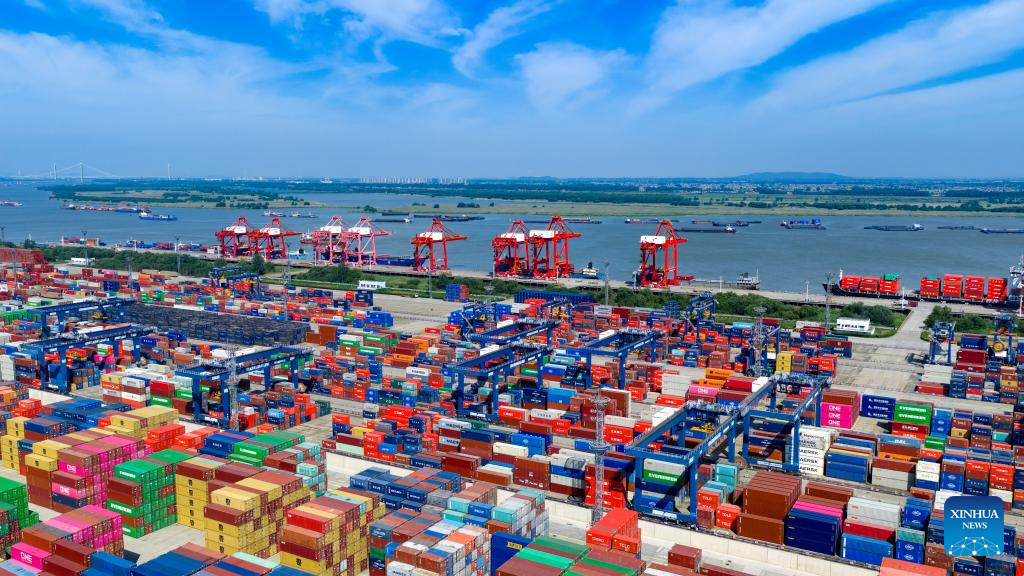
A drone photo taken on May 17, 2026, shows a view of the Longtan Container Terminal at Nanjing Port, East China's Jiangsu province. [Photo/Xinhua]
Furthermore, China's commitment to a shared future offers an alternative model of international leadership — one based on mutual respect, non-interference and shared development rather than military alliances and bloc confrontation. By inviting 100,000 American young people to visit China for exchanges and study over the next five years, and welcoming business leaders and cultural representatives to engage directly with China, Beijing is helping to broaden mutual understanding and strengthen the social foundations for a stable, peer-based relationship.
Public opinion research indicates that American views of China are improving, a trend most pronounced among younger Americans.
The transition to a multipolar world need not be marked by a violent translatio imperii — a chaotic transfer of imperial dominance from one hegemon to another. Instead, China is championing an international framework in which no single nation dictates the rules for all. By treating the United States with respect while firmly upholding its own sovereign rights and development interests, particularly on the Taiwan question, China is demonstrating how major countries can coexist as peers, ensuring that the transition to multipolarity remains orderly, peaceful and mutually beneficial.
As Xi has emphasized, both China and the United States are great countries, and both the Chinese and American peoples are great peoples. Working together, the two nations can lengthen their list of cooperation, and shorten their list of issues. Now that the two sides have agreed to build "a constructive relationship of strategic stability based on respect, fairness, and reciprocity," hopefully, the world will see the bilateral ties characterized by more communication, more stability, and more cooperation in the coming months and years.
Warwick Powell is an adjunct professor at Queensland University of Technology.