中文
中文

By Warwick Powell
Xi Jinping's back-to-back appearances in Bishkek and Cairo demonstrate that China is helping build the trade, payment and technical infrastructure that lets other states make their own choices.
For decades, international relations theory has interpreted global order through a rigid, closed-system lens. Conventional commentary evaluates power through Newtonian metrics: force ratios, binary alliances and the static management of balance-of-power equilibria. When strategic landscapes become highly fluid, whether across the energy corridors of West Asia or the maritime supply routes of East Asia, this traditional framework falters. It treats flux as chaos to be suppressed, mistaking structural phase transitions for temporary disruption.
The emerging multipolar reality requires a fundamental analytical shift. International systems do not operate as closed analytical frameworks seeking balance. They are open, dynamic networks defined by real-economy flows, technical infrastructure and evolving institutions. Power in the 21st century is not abstract leverage applied by a coercive hegemon. It is an operational effect produced through the continuous assembly of physical supply chains, financial payment rails, technological standards and diplomatic agreements.
When the material foundations of legacy security umbrellas atrophy, the answer is not to double down on exclusive military blocs or punitive sanctions. It is to build open, resilient networks capable of stabilizing global development. China is charting a distinct diplomatic path in this landscape, acting as a great enabling power —a curator of open network formation, expansion and stabilization. An enabling power does not seek to command allies or impose political conditions; rather, it expands the available space for partners to exercise their own sovereign choices.
Building the Eurasian network
This approach was on display during Chinese President Xi Jinping's attendance at the 26th Meeting of the Council of Heads of State of the Shanghai Cooperation Organization (SCO), held in Bishkek on Sept. 1, and his state visit to Egypt.
Over 25 years, the SCO has expanded from a regional security arrangement focused on terrorism, separatism and extremism into a comprehensive multilateral architecture. Its remit now integrates transport corridors, agricultural trade platforms, green energy partnerships, cooperation in digital technologies and artificial intelligence governance, and independent financial infrastructure.
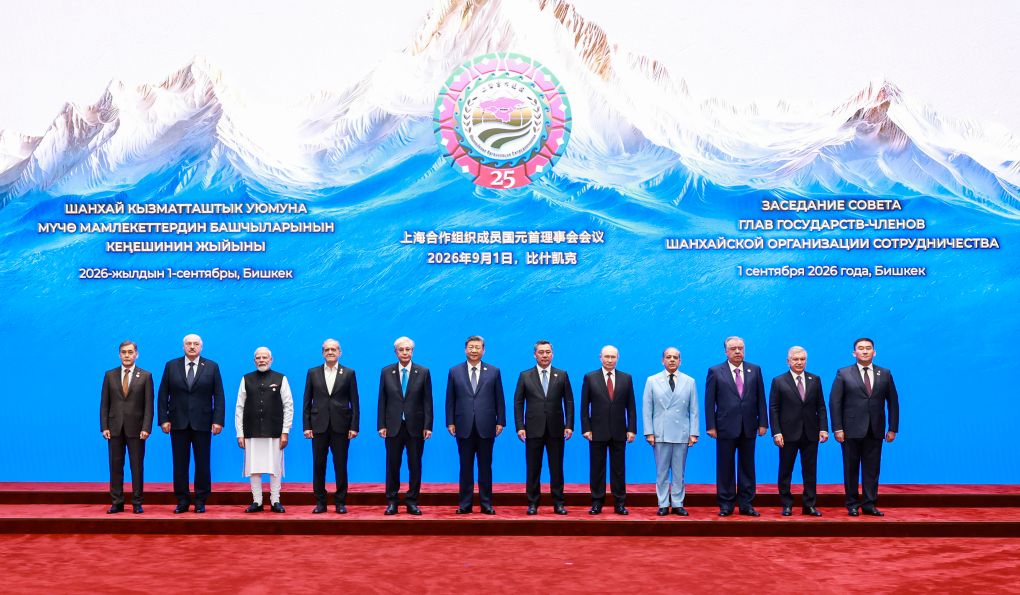
Chinese President Xi Jinping poses for a group photo with leaders of the Shanghai Cooperation Organization (SCO) member states in Bishkek, Kyrgyzstan, Sept. 1, 2026. Xi attended the 26th Meeting of the Council of Heads of State of the SCO held here on Tuesday. [Photo by Wang Ye/Xinhua]
Viewed through legacy alliance theory, the SCO presents a puzzle. It brings together member states with diverse political systems and real bilateral frictions, such as India and Pakistan. Yet it thrives precisely because it rejects the binary, zero-sum logic of military alliances.
Rather than demanding strategic subordination, China's diplomacy within the SCO focuses on principle-driven inclusive engagement, the active process by which a coordinating partner aligns diverse entities — sovereign states as primary political actors alongside practical infrastructure tools such as payment rails — by addressing their shared practical needs.
By co-creating shared technical standards, energy consortium frameworks and non-dollar clearing systems, the SCO integrates member states into mutually beneficial networks. It manages regional frictions by embedding historical rivals within an integrated network of material-economic ties, making conflict prohibitively costly.
Proposed mechanisms such as the SCO Development Bank, localized currency clearing and common digital portals also drive standardization: common protocols, legal rules and technical norms across borders that turn complex strategic alignment into a streamlined, regular pattern of cooperation. These platforms do not merely bypass external coercion. They build resilient pathways for economic development.
The active engagement of member states across Eurasia, even as external actors attempt to enforce economic isolation, demonstrates the power of network-driven expansion, the way a network builds self-reinforcing momentum, gaining systemic weight and authority as it integrates more nodes until staying outside becomes cost-prohibitive. Strategic isolation tends to become less effective when a nation is embedded within an expansive Eurasian institutional framework.
By advancing the Shanghai Spirit of mutual trust, mutual benefit, equality, consultation, respect for diversity of civilizations and the pursuit of common development, China's role in the SCO shows how an enabling power builds institutional spaces that preserve sovereign diversity and strengthen collective resilience.
Opening options for Egypt
Xi arrived in Cairo on Sept. 1 for a two-day state visit that coincided with the 70th anniversary of bilateral diplomatic relations, exemplifying diplomacy as enablement in a region in transition. West Asia and North Africa are undergoing a profound realignment. Regional powers are exploring regionally-rooted defense and economic frameworks, seeking to move away from reliance on external military projection and toward security architectures rooted in proximity and mutual necessity.
Traditional power analysis often assumes that regional security pacts require an external military patron to act as an enforcing hegemon. The diplomatic reality in Cairo demonstrates a different mechanism: China acting as a material partner. Rather than demanding exclusive military concessions or imposing political conditions, China's engagement with Egypt opens practical options and operational pathways for the regional system. By providing tangible possibilities and courses of action, this cooperation enables Egypt to take independent steps that were previously constrained.
Through expanded trade integration, joint industrial projects, technological cooperation in artificial intelligence and bilateral local currency swap arrangements, Beijing opens these practical opportunities for Cairo. By offering non-coercive access to capital, technological infrastructure and market demand, China enables states such as Egypt to navigate regional flux without being forced into rigid, bloc-based alignments.
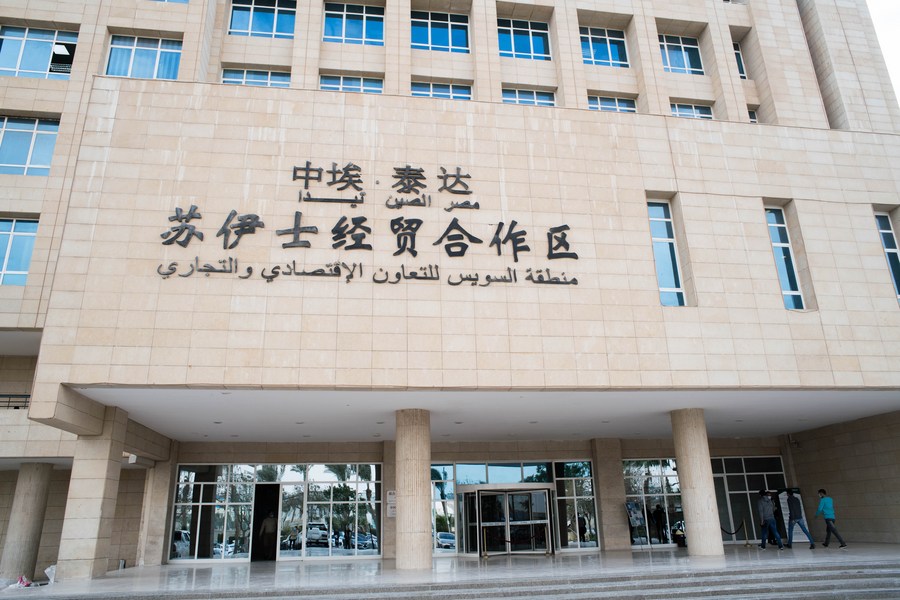
Photo taken on Jan. 14, 2021 shows the office building of China-Egypt TEDA Suez Economic and Trade Cooperation Zone in Ain Sokhna, Egypt. [Photo by Wu Huiwo/Xinhua]
Regional initiatives aimed at de-escalation and good neighborliness require a stable economic foundation, and China's role as an economic and industrial partner gives neighboring states the confidence to construct self-sustaining regional security frameworks. By aligning the Belt and Road Initiative, BRICS expansion and SCO functional partnerships, Chinese diplomacy helps bridge Asian and African institutional spaces, fostering a networked multipolarity anchored in the Global South.
Multipolarity in the making
The diplomacy on show in Bishkek and Cairo reveals that the current geopolitical flux is not a descent into disorder. It is the generative space within which a multipolar order is being actively assembled.
Where traditional Western ordering relies on military alliances, zero-sum security blocs and coercive financial bottlenecks, China's practice as a great enabling power introduces a new paradigm. Through the Global Development Initiative, the Global Security Initiative, the Global Civilization Initiative and the Global Governance Initiative, Beijing is not seeking to replace one hegemon with another. It is providing the material platforms, technical standards and institutional architecture that allow sovereign states to co-create their own security and development outcomes.
By anchoring global governance in the principles of indivisible security and good neighborliness, diplomatic enablement offers a stable path forward. Power in a multipolar era belongs to those who build, connect and enable. Through the development of open, cooperative networks and tangible economic support, China is helping the evolving international system move from volatile flux to a durable, cooperative multipolar reality.
Warwick Powell is an adjunct professor at Queensland University of Technology.