中文
中文

By Zhang Heling
Global public opinion is undergoing a profound realignment, with China's international image improving significantly relative to that of the United States, speakers told an international conference in Beijing on Wednesday. The shift, they said, is being driven by tangible economic realities and contrasting foreign policy approaches.
The International Symposium on Shifting Global Perceptions and China's Future Development, hosted by the Chongyang Institute for Financial Studies and the School of Global Leadership at Renmin University of China, brought together former dignitaries, scholars and envoys from more than 17 countries.
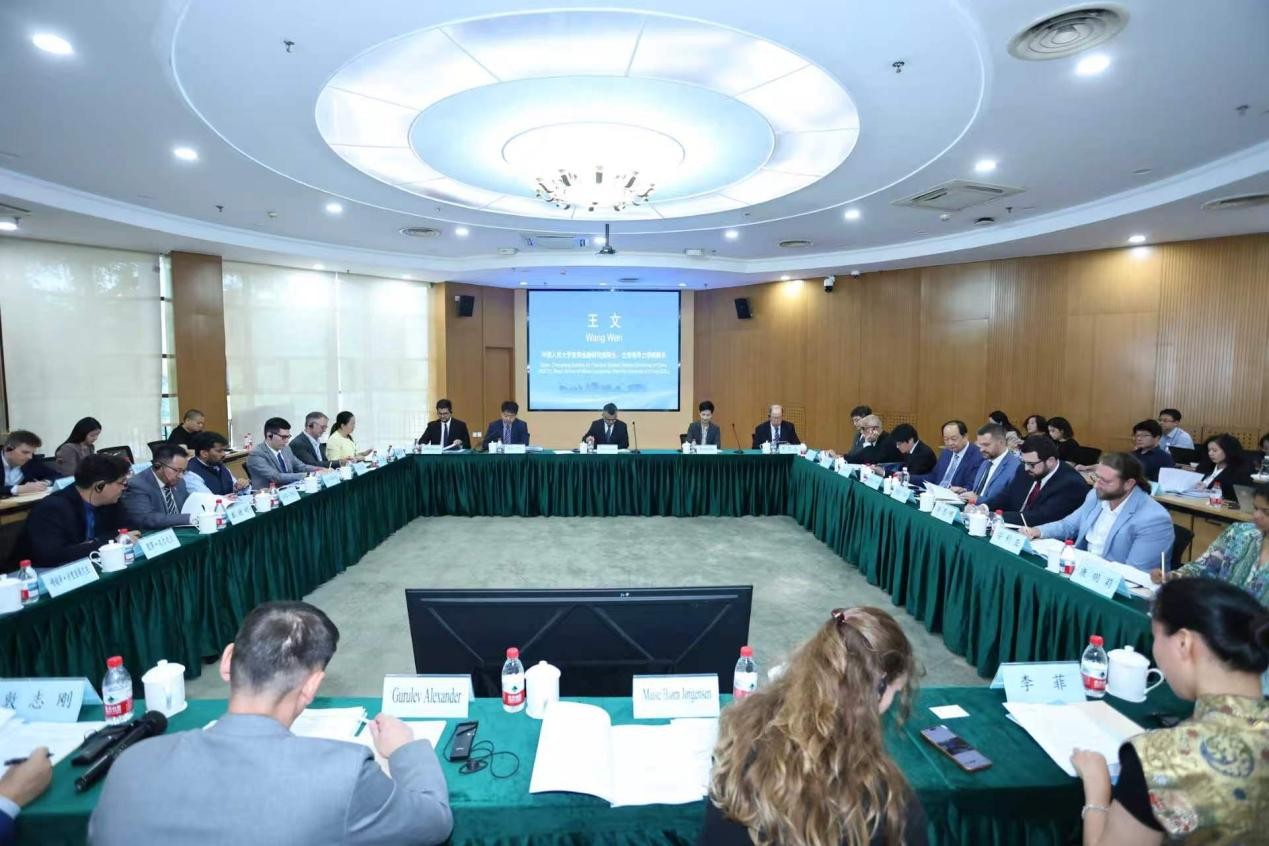
The International Symposium on Shifting Global Perceptions and China's Future Development is held in Beijing on Aug. 26, 2026. [Photo courtesy of Chongyang Institute for Financial Studies, Renmin University of China]
Laura Silver, associate director of global attitudes research at the Pew Research Center, delivered the symposium's keynote address. Citing a new spring 2026 survey of more than 45,000 people in 37 countries, Silver noted that a median of 51% now hold a favorable view of China.
In more than one-third of the nations surveyed in recent years, perceptions of China have improved, with favorability at or near historic highs in several middle-income countries.
"China is seen as a contributor to global peace and stability and as a country that takes the interests of countries like theirs into account," Silver said.
Views of the U.S. have deteriorated significantly, the survey found, particularly regarding its reliability as a global partner. In most countries surveyed, China is now viewed more favorably than the U.S.
Former Slovenian President Danilo Türk echoed that assessment, contrasting China's "stable, peaceful and cooperative" foreign policy with the "volatile, unpredictable and confrontational" approach of the U.S.
He cited China's role in stabilizing global oil markets and its expansion of tourism, which enables more international visitors to witness its technological and urban development firsthand, as factors fostering a more positive perception.
The economic foundation of the shift was a central theme. Zheng Xinye, vice president of Renmin University of China, said China's development has tangibly benefited global consumers.
"China's growth has led to higher production volumes, lower prices and better quality for almost all products, benefiting consumers worldwide," he said, pointing to sectors such as photovoltaics and 5G. Although the vast majority of beneficiaries remain "silent" in global media, he said, their lived experience shows up in opinion polls.
He described China's domestic policies, centered on people's well-being and equal access to public services, as a model contributing to global stability.
Adding a historical perspective, John Ross, former director of economic and business policy for the mayor of London, argued that long-term economic outcomes often reshape international perceptions, saying, "Reality is more powerful than perceptions."
Some Western theories predicting China's economic collapse have been repeatedly proven wrong by China's successes in manufacturing and technology, he said, citing companies such as BYD and ByteDance's TikTok as examples of Chinese innovation that overcame initial skepticism.
The world is increasingly recognizing the benefits of China's stable development and its vision of a community with a shared future for humanity, Ross said.
Speakers broadly agreed that the current shift is not a "China-centric" pivot but a move toward a more multipolar world. Edemilson Parana, a professor at University College Dublin, cautioned against viewing the change as a binary choice, saying many countries, particularly in the Global South, are seeking greater strategic autonomy and more diverse partnerships. A nation's image is ultimately built on its actions, not its communications, he said.
Zhang Di, a professor at the School of Journalism and Communication at Renmin University of China, presented data linking the decline in U.S. favorability to global perceptions of instability caused by unilateral actions. A chaotic international order benefits no major power, he said, underscoring an urgent need for international cooperation — a call echoed strongly by nations in the Global South.
The symposium concluded that China's growing global favorability is rooted in its economic achievements and stable foreign policy, but that the future will require navigating a complex, multipolar landscape in which national interests and perceptions continue to evolve.
The event also marked the release of a report, "Global Perceptions in Profound Transition: China Toward 2050 and Long-Term Trends in How the World Views China."