中文
中文

By Einar Tangen
Eighty-five years on, the Flying Tigers remain a reminder of what people from different countries can do when they choose to stand together against fascism.
On Dec. 20, 1941, Japanese bombers approached Kunming with confidence. For years, the Japanese air force had dominated China's skies, inflicting heavy damage with impunity. This time, they met 16 shark-nosed P-40 fighters. The pilots tore into the formation, shooting down three bombers and damaging six more. The result was decisive: nine of the raiders were hit or destroyed and the defenders lost not a single aircraft.
For a city living under the shadow of constant, indiscriminate Japanese bombing, it was more than a military success. It was a turning point and a psychological liberation. China was not alone in the war against fascism. The Chinese people gave these pilots a name that captured their spirit: the Flying Tigers.
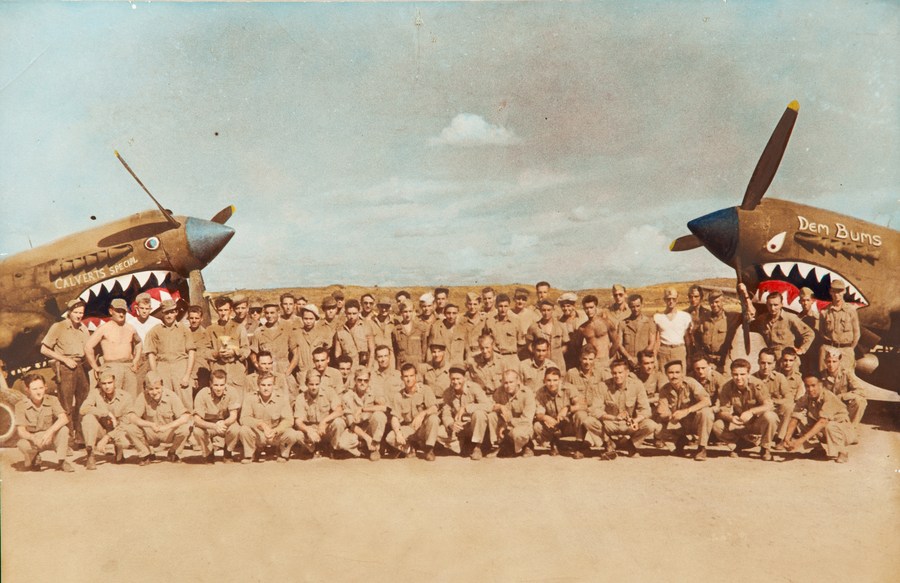
Members of the 76th Squadron of the 23rd Fighter Group of the 14th U.S. Air Force, in which Flying Tiger pilot Glen Beneda served as a pilot, pose for photos in front of two shark-teeth fighter planes in China during World War II. [Photo/Xinhua]
Eighty-five years later, the story remains powerful because it reveals a fundamental difference between the actions of states and the actions of individuals. Governments calculate. They weigh interests, alliances, risks and strategic advantage. Individuals operate through something different: conviction, empathy, loyalty, courage and a willingness to sacrifice for what they believe.
The Flying Tigers were created out of the needs of national strategy but sustained by the personal choices of individuals.
The American Volunteer Group was never simply a spontaneous gathering of volunteers. It was a carefully constructed instrument of policy. In 1941, as Japan expanded across Asia, President Franklin D. Roosevelt authorized a secret air unit to assist China while the United States remained officially neutral. It was clear, even then, that Japan's expansion was not merely territorial ambition — it was driven by a fascist ideology that viewed conquest and subjugation as the natural order, an ideology that threatened the very foundations of international peace and human dignity.
American pilots were released from military service and recruited through the Central Aircraft Manufacturing Company. Officially, they were civilians. In reality, they were joining a secret war. The arrangement reflected the geopolitics of the time. Washington was concerned about Japanese expansion and Japan's role in the Axis powers— a fascist bloc that sought to redraw the world order through conquest and racial hierarchy. Yet the U.S. Congress had not authorized direct action. Britain had concerns about its colonial interests in Asia, particularly Burma (present-day Myanmar), a critical supply line for China. China needed air cover to defend its cities and protect the Burma Road, one of its last remaining connections to the outside world. For China, the fight was existential — a struggle against fascist aggression that had already claimed millions of lives.
Strategy may have created the Flying Tigers, but it was something else that made them fly.
The men who joined the Flying Tigers were not instruments of government policy. They were individuals who made personal decisions that carried enormous risks. Their commander, Claire Chennault, arrived in China in 1937 to advise the Chinese air force. After witnessing Japanese attacks on Chinese civilians, he chose to stay. He understood that his contribution might be small, but believed it could matter. He wrote to his brother that the effort, small as it was by comparison, might influence history for hundreds of years.
The pilots who followed him came from remarkably different backgrounds. Some were professional military men. Others were adventurers, misfits or young men looking for something larger than themselves. Most were in their 20s. Many left the United States in July 1941, before Pearl Harbor. They crossed the Pacific knowing they were entering a dangerous and uncertain war.
Among them were Robert Neale, Robert T. Smith, Charles Older, George Burgard and Charles Bond. Gregory "Pappy" Boyington, who later received the Medal of Honor as a Marine Corps pilot, was drawn into the war in China. Others, such as David Lee "Tex" Hill, became celebrated fighter pilots through their courage and the number of missions they flew.
They were labeled mercenaries, but their actions went beyond any contract. Many continued to fight beyond their original commitments. They endured rudimentary conditions, inadequate supplies, overwhelming odds and the constant specter of death, reflected in the comrades they lost. Their commitment exacted a terrible price. Over 2,000 Flying Tigers died in the operations. They did not fight for territory or ideology of domination. They fought against a system that reduced human beings to expendable cogs in a machine of conquest.
But the story was never exclusively American. The wider air war in China brought together people from Britain, Canada, Australia, France, the Netherlands and elsewhere. The China National Aviation Corporation became one of China's most important wartime lifelines, carrying supplies across the Himalayas on the perilous route that became known as the Hump. Its crews included Americans, Chinese, Canadians and Chinese Canadians.
Among the Canadians were Archie St. Louis, Russell Weaver and Harold Chinn. Perhaps the most remarkable were Albert and Cedric Mah, Chinese Canadian brothers from Prince Rupert, British Columbia. They had trained as instructors under the British Commonwealth Air Training Plan. They could have remained in Canada. Instead, they went to China.
Albert Mah flew 420 Hump missions. That number tells something about the war, but nothing about the man. He was Canadian by birth and Chinese by heritage. His decision to fly into one of the most dangerous air corridors in history reflected a personal connection to China that had nothing to do with the strategic interests of Ottawa or Washington.
Others came from equally unexpected backgrounds. Gerhard Neumann, a German-born engineer and mechanic, joined Chennault's operation and was known to the Americans as "Herman the German." The war complicated his nationality, yet he found himself working alongside Americans and Chinese against Japanese militarism.
This diversity matters because it challenges the idea that the Flying Tigers were simply an American formation. The original American Volunteer Group was American. But the larger story was international, made up of people whose individual circumstances brought them into the same struggle.
The Chinese side of the story is central to understanding the Flying Tigers’ legacy. China did not simply wait for foreigners to defend it. Chinese pilots, mechanics, engineers, students and civilians were fighting on behalf of their motherland. Lee Chia-ho is one example. A physics student at the National Southwest Associated University in Kunming, he came from an educated family and had opportunities to pursue a professional life away from the battlefield. Instead, he volunteered for aviation training and was sent to the United States for advanced instruction.
He never came home. Lee was among the Chinese aviation trainees who died while training in the United States during the war. He had chosen a calling in which the odds of survival were already frighteningly low. His story illustrates the same personal calculation the Americans made: a safe life was possible, but something greater demanded sacrifice.
One Chinese flying school put the choice in brutally simple terms. Those who came for promotion or wealth should choose another path. Those who feared death should not enter.
That was not rhetoric. It was reality. These men were not chess pieces. They were students, sons, mechanics, engineers and adventurers. They had families. They had career opportunities. They had futures that they surrendered because they believed the present demanded something else.
This is where the story becomes more than military history. What ultimately bound the Flying Tigers and the Chinese together was not strategy but empathy, or a shared determination to defeat fascism.
The American pilots might not have heard of the inhumane biological warfare carried out by Unit 731 of the Imperial Japanese Army. They might have merely heard about the Nanjing Massacre. But they saw Chinese cities being bombed. They saw civilians running from burning buildings. They saw families losing their homes and children becoming refugees. China was no longer a place on a map. It became a people enduring unimaginable hardship under the guns and boots of a fascist aggressor.
The Chinese saw young Americans arrive from thousands of miles away and risk their lives defending Chinese cities. The pilots were foreigners, young men who despite their bravado were frightened, who were wounded and who died.
The relationship became personal. When American airmen were shot down over Japanese-occupied territory, Chinese civilians risked their lives to save them. After the Doolittle Raid on Tokyo in April 1942, Japanese forces launched brutal reprisals against Chinese communities suspected of helping American airmen. Thousands of Chinese civilians were killed in retaliation.
Yet people continued to help. Villagers hid pilots. Farmers provided food. Families opened their homes. Chinese soldiers and civilians organized rescue networks that moved downed Americans from one safe location to another.
More than 200 American airmen survived because Chinese people chose to protect them. That was not geopolitics. A farmer hiding a foreign pilot did not know what Washington might gain from the rescue. He knew only that a human being who had risked his life to protect his country's future was in danger.
Empathy became action.
And action created trust.
This is perhaps the most important legacy of the Flying Tigers. Courage is contagious, but it rarely exists in isolation. It is strengthened when people believe that others will stand with them.
An American pilot who knew that Chinese civilians would risk their lives to rescue him drew strength from that bond. A Chinese villager who saw American pilots risking their lives to defend Chinese cities had reason to believe that resistance was possible.
Courage produced empathy. Empathy produced trust. Trust produced more courage.
The military contributions were substantial. The Flying Tigers and their successors destroyed Japanese aircraft, defended Chinese cities and helped protect the supply routes that kept China's resistance alive. The Hump airlift became one of the most dangerous logistical operations of the war. Hundreds of aircraft were lost and thousands of Allied airmen died in China and the surrounding theater.
But the physical contribution tells only half the story.
The psychological contribution was equally important.
Japan had appeared to possess overwhelming military superiority. The arrival of the P-40s showed that Japanese aircraft could be challenged and defeated. For Chinese civilians who had spent years under bombardment, that mattered. It gave them hope.
Military power can destroy aircraft, bases and supply lines.
Morale determines whether people continue to fight for justice and human dignity.
The Flying Tigers gave China something that could not easily be measured: the confidence that it was part of the greater cause against fascism.
The men who fought in China were individuals, not nationalities. Some were American. Some were Chinese. Some were Canadian. Some were Chinese Canadian. Others came from Britain, Australia and elsewhere. Their governments had different interests and their personal histories were different.
But when they faced the danger of fascism together, those differences became less important. They discovered something more fundamental: a shared humanity.
That is why the story still matters 85 years later.
The wartime governments and leaders that created the anti-fascist alliance are long gone. The strategic calculations of 1941 changed with the end of the war. The aircraft have become museum pieces. The pilots have passed into history.
But the memory remains: a Chinese villager risking his life for an American pilot, a Chinese Canadian brother flying hundreds of missions over the Himalayas, a Chinese student leaving university to become an aviator, a young American climbing into a P-40 to defend a country thousands of miles from home.
States make calculations.
People make choices.
And sometimes the choices of ordinary people prove more enduring than the calculations of governments.
The Flying Tigers remind us that the strongest bonds between peoples are not necessarily created by treaties. They are created when individuals see the humanity of others and are willing to take risks on their behalf. In turn, they discover that among people who love peace and freedom, courage given is courage returned.
The defeat of fascism in 1945 was not merely a military victory. It was a moral affirmation that no ideology of imperial conquest can legitimize the oppression of others. The legacy of the Flying Tigers is not only a story of courage and friendship. It is a reminder that the fight against fascism — in all its forms — is a cause that transcends borders, generations, and national interests.
Einar Tangen is an American commentator on current affairs.