中文
中文

By Matteo Giovannini
Xiamen is competing with Valparaiso and Brussels to host the High Seas Treaty permanent secretariat. Its coastal record, maritime research capabilities and China's financial pledge make it a serious contender.
The entry into force of the Agreement on Marine Biological Diversity of Areas beyond National Jurisdiction, better known as the BBNJ Agreement or High Seas Treaty, on Jan. 17, 2026, marked an important milestone in marine conservation. It also opened a new chapter in the governance of one of humanity's most important shared resources, the vast areas of ocean beyond national jurisdiction.
The treaty now faces the challenge of moving from negotiation to implementation. Three cities are competing to host its permanent secretariat: Xiamen in China, Valparaiso in Chile and Brussels in Belgium. The decision will determine more than the location of an international office. It will also help shape the geographic and institutional character of the treaty as countries turn its commitments into practical cooperation.
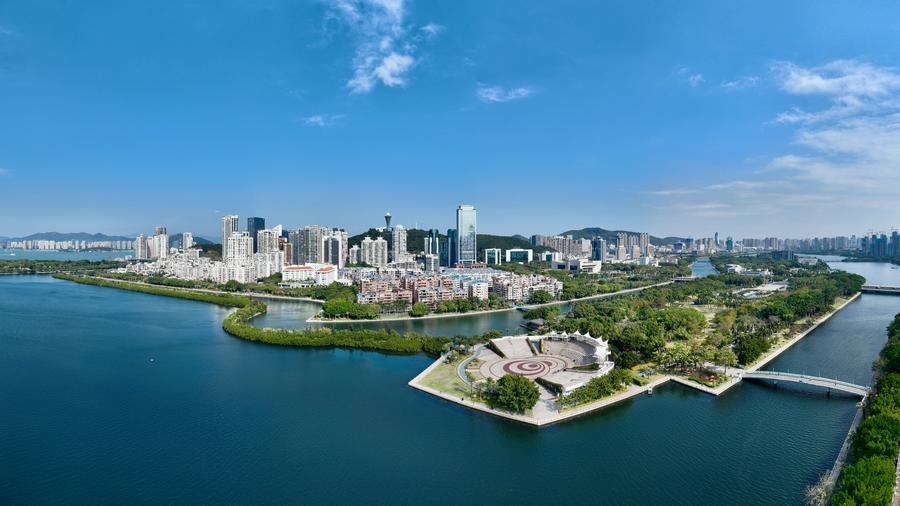
An aerial panoramic drone photo taken on Jan. 24, 2024 shows Yundang Lake and its surroundings in Xiamen, southeast China's Fujian Province. [Photo by Jiang Kehong/Xinhua]
For China, the bid to host the secretariat in Xiamen offers an opportunity to show that its growing role in global affairs extends to the stewardship of global commons. It also provides a practical platform for advancing the vision of a maritime community with a shared future, as proposed by China and supported by a growing number of nations.
The BBNJ Agreement is particularly significant because areas beyond national jurisdiction cover nearly two-thirds of the world's oceans. These waters lie beyond the control of individual states, yet they are essential to the health of the planet. Marine biodiversity supports food chains, climate regulation and scientific discovery, while fishing, shipping and seabed activities can affect ecosystems across national boundaries. The treaty reflects a broader reality of international affairs: no country can address the world's most pressing challenges alone.
China has positioned itself as an active participant in this emerging system of ocean governance. It ratified the BBNJ Agreement before its entry into force and has emphasized multilateral cooperation in protecting marine biodiversity. Its bid for Xiamen is a logical extension of this engagement and would place the treaty's permanent secretariat in an Asian maritime city with growing experience in international cooperation.
China has also expressed its commitment to allocating resources for the treaty's implementation. According to recent reports, Beijing has pledged $3 million to the BBNJ trust fund to support participation by developing countries. The Xiamen proposal also includes a dedicated office building and measures to support capacity building. Such commitments could prove valuable because the treaty's success will depend not only on its rules but also on whether developing countries have the scientific and institutional capacity to implement them.
Xiamen has a distinctive story to tell. Located in Fujian province, the coastal city has spent decades seeking to reconcile economic development with marine ecological protection. Its experience includes the restoration of coastal wetlands and mangrove ecosystems, marine habitat protection and the development of marine scientific research. These efforts have helped establish Xiamen as an example of how environmental protection can be integrated into urban development.
The city has also developed experience in international marine cooperation. In May, Xiamen hosted an international symposium that brought together officials, researchers and experts to discuss ocean governance, marine biodiversity and sustainable development. Such events have strengthened the city's connections with the international ocean community and demonstrated its capacity to facilitate scientific and policy cooperation.
The broader Chinese experience is also relevant. China has expanded its marine ecological conservation efforts in recent years, including the restoration and protection of mangrove ecosystems. These initiatives show the potential of combining ecological restoration, scientific research, environmental regulation and economic development. Domestic achievements on their own cannot address global ocean challenges, but they provide practical experience that can contribute to international cooperation.
This experience is closely connected to China's vision of building a maritime community with a shared future. The ocean connects rather than separates countries. Marine pollution crosses borders, species migrate across jurisdictions and climate change affects coastal communities regardless of where emissions originate. Protecting the ocean therefore requires countries to share responsibilities while ensuring that the benefits of marine resources and scientific progress are broadly distributed.
The BBNJ Agreement provides a natural arena in which this approach can be put into practice. Its implementation will require cooperation in marine scientific research, information sharing and technology transfer, as well as the establishment of marine protected areas and other management tools. It will also require mechanisms for the fair sharing of benefits arising from marine genetic resources. None of these objectives can be achieved through unilateral action.
The competition among Xiamen, Valparaiso and Brussels consequently carries significance beyond the location of the secretariat. Brussels offers proximity to European institutions and an established multilateral environment. Valparaiso would strengthen the treaty's connection with Latin America and the Pacific. Xiamen would bring the institution closer to Asia and to a country that has become increasingly active in international ocean governance.
The final choice should rest on which candidate can best help the secretariat fulfill its mandate. Scientific capacity, accessibility, institutional support and the ability to facilitate developing-country participation should matter more than geopolitical symbolism. Xiamen's combination of coastal experience, marine research capabilities, international engagement and China's proposed financial support gives its bid a strong foundation.
There is inevitably a geopolitical dimension to the competition. China's expanding role in international institutions is being closely watched, and its bid will be assessed against the broader debate about China's place in global governance. That scrutiny is understandable, but it also makes the opportunity more consequential. If China wants to be seen as a responsible major country, global environmental governance is an area where responsibility must be demonstrated through concrete contributions rather than declarations.
Hosting the BBNJ secretariat would not give China ownership of the treaty, nor should it. The agreement belongs to its parties and is grounded in the multilateral framework of the United Nations Convention on the Law of the Sea. But a successful secretariat in Xiamen could give China the chance to show how a major developing country can contribute financial resources, scientific expertise and institutional capacity to the governance of a global commons.
Ultimately, the future of the high seas cannot belong to any single country or region. It belongs to all countries and to generations yet to come. The BBNJ Agreement represents a collective attempt to protect this shared space, and its success will depend on translating that commitment into effective conservation, scientific cooperation and equitable participation.
For China, putting forward Xiamen therefore goes beyond merely hosting an international institution. It is an opportunity to show that the vision of a maritime community with a shared future can move from a well-received concept to practical cooperation. The high seas are a shared responsibility, and the next chapter of their governance must be built on that principle.
Matteo Giovannini is a finance professional at the Industrial and Commercial Bank of China and a member of the Global Young Leaders Dialogue.