中文
中文
By Josef Gregory Mahoney
Lead: Beijing takes no joy in America's unraveling, knowing from its own history the pain of political chaos and societal collapse.
We might understand the United States as a tragedy, an empire experiencing precipitous decline. We might see it as a comedy amid MAGA's nostalgic farce playing out repeatedly (was it not inevitable that such a drug-addled society would relapse?).
And yet, should we speak so callously of a national breakdown — as cold as ICE in frigid Minneapolis? Or would that very coldness be a symptom of collapse itself?
Whether the U.S. is collapsing or merely transitioning is a matter of fierce debate. Some admit the U.S. is experiencing a period of intense transformation and renegotiation, including a painful and conflict-ridden remaking of its social and political order, but reject the sort of apocalyptic teleology they associate with collapse theorists.
Some believe we are witnessing the sort of strategic simplification experienced by the United Kingdom after World War II, which left the metropole intact and the empire barely a commonwealth, but no great end to all things.
Conversely, following the ideas of Joseph Tainter and John Michael Greer, some argue that the U.S. is undergoing a catabolic collapse. They point to historical examples such as the Western Roman Empire, the Byzantine Empire, the Maya, the Ming dynasty and, by some accounts, the Soviet Union.
In this view, collapse occurs in stages and involves misguided or self-defeating acts of aggression, various forms of self-cannibalization, and a deepening spiral of crises that generate further crises.
Also possible: a combination of the two, where the U.S. reasserts hegemony as much as possible over a more limited part of the world, e.g., in the Western Hemisphere via the Monroe Doctrine, while amplifying rent-seeking and neo-mercantilist policies globally to extract as much value as it can in its remaining window of opportunity.
Whether a strategic simplification, a catabolic collapse or a mix of the two, whether a chronicle of death foretold or an opportunity for rebirth, the empire has already reached its end. Such are the remains of the day. It is no longer a question of if, when or why. Already, the U.S. is beset with political polarization, institutional erosion, unsustainable fiscal and monetary trajectories, social fragmentation and growing inequality, infrastructure and systemic decay, and a growing inability to exercise power unilaterally or effectively in international affairs.
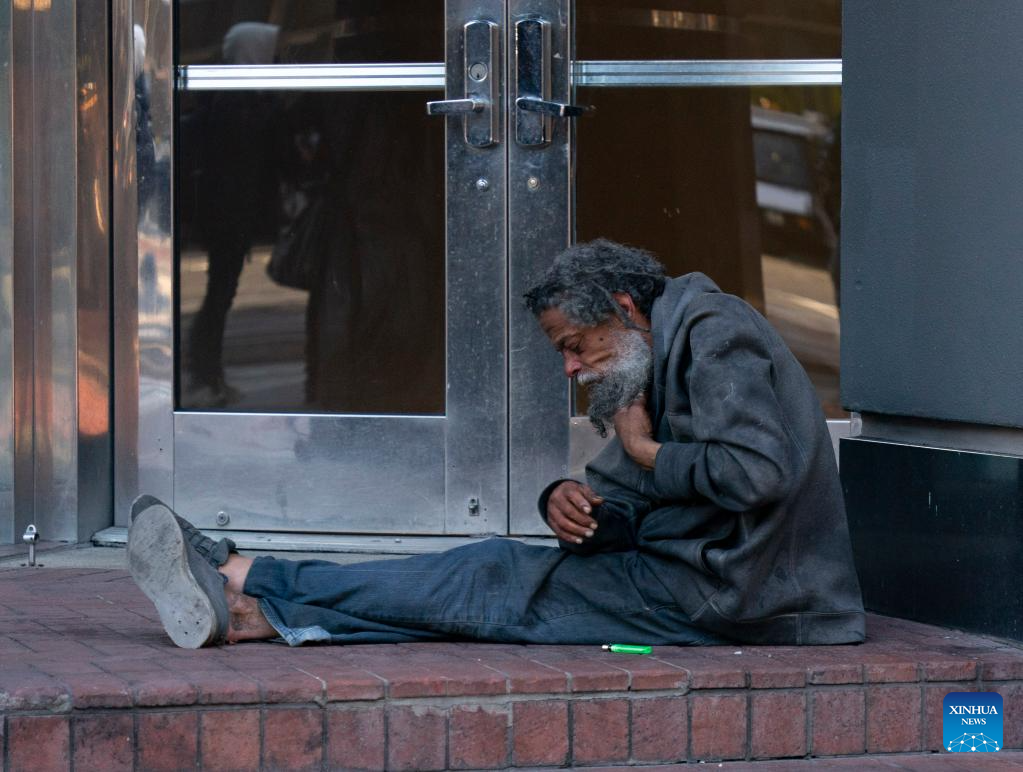
A homeless man is pictured in San Francisco, California, the United States, Dec. 23, 2023. [Photo by Li Jianguo/Xinhua]
The downward spiral of charisma
In his classic "Economy and Society" (1922), Max Weber noted the prevalence of charismatic politics in societies facing various forms of distress.
Later scholars expanded on his analysis, observing that the rise of new media not only heightened public awareness of social problems but also fostered the emergence of celebrity politicians. These figures often relied on charisma and spectacle — traits that frequently conflicted with the ability, and even more with the willingness, to achieve meaningful change.
This is where the phenomenon encounters its Achilles' heel: charismatic politics can only establish legitimacy by delivering what constituents have been promised, promises that increasingly are impossible to deliver, and all the more so given recourse to hyperbole and, quite often, violence.
Indeed, as a society's problems continue to mount and the ability to govern and correct course declines, promises must become even more spectacular.
Because such a system is deeply resistant to real change — because in its diminished state it becomes even more entrenched and incapable of change — scapegoating becomes the norm. Blaming others for society's problems, whether political opponents, immigrants, or other countries, turns into a defining pattern, accompanied by growing outbursts of state violence at home and abroad. After all, at the very least, the commander in chief commands the gun.
Chinese perspectives
No civilization has a longer continuous history than China, and this includes an unsurpassed experience with periodic rising and falling. While China is making a century-long effort to actualize national rejuvenation, with key milestones reached, the U.S. has moved in the opposite direction. For the Chinese people, the chaos increasingly gripping America today is not a matter of morbid curiosity but a reaffirmation of renewed cultural wisdom, which has attracted a number of increasingly popular tropes in public discourse in the country.
Recently, various Chinese expressions have percolated in popular discourse, including "xi luan dong zhi" (西乱东治), which translates as "Western chaos, Eastern order," and even more specifically, "mei luan zhong zhi" (美乱中治), which translates as "America in chaos, China in order."
For many, these turns of phrase do not indicate a sense of cultural superiority or even a sense of national pride, because the Chinese understand quite well the dark wages of chaos, charisma and collapse, and likewise the tremendous sacrifices required to reestablish and maintain order, above all in a world where disorder risks becoming the norm.
Many around the world, including Chinese and American citizens, are worried that this type of degeneration is taking hold in the U.S. Again, because of the long view of Chinese civilization, we can point to the Spring and Autumn and Warring States periods of Chinese history, when China was also experiencing decline and growing disorder. We can consider the modern significance of the critical insights raised by the leading Chinese thinkers of that time.

Tourists take selfies at Tiantan (Temple of Heaven) Park in Beijing, capital of China, Oct. 1, 2024. [Photo by Chen Xiaogen/Xinhua]
The Confucians, concerned with moral failure, would highlight concerns like those related to the Epstein scandal. The Taoists, espousing a first principle of harmony between people and nature, would point to Trump's denial of climate change and dark determination to dominate the world through fossil fuels. The Mohists, dedicated to universal love, would castigate America's intense polarization and the high rates of interpersonal and systemic violence, including that directed against migrants and other countries. The Legalists, committed to strong institutions and the rule of law, would decry the politicization of the Department of Justice, the FBI and the courts, and would likewise criticize the abandonment of international organizations and the erosion of international law.
From that same era, recall Mencius' warning: "When a state is about to flourish, its people are spared; when it is about to perish, its people are consumed." How well this difficult historical lesson has been learned by modern China, and yet, the American elite have never tasted this hardship and do too little to avoid it.
A note on leadership and historic exploits
Mao Zedong, the greatest revolutionary in history and a powerful, charismatic figure, was without question an agent of radical change and would even open the door to chaos if he believed that a new order required a measure of disorder.
Indeed, this was only half his genius: the other half is that he is history's greatest political organizer and institution builder, laying the foundations of the Communist Party of China (CPC) and the People's Republic of China, both of which his political descendants have now seen to maturity, above all the consolidations actualized by Xi Jinping. Perhaps this signals a cultural capacity for offsets, the propensity of a people accustomed to dialectics instead of aporetics.
Perhaps observing America's woes is a ready reminder that true legitimacy and efficacy require a responsible helmsman and estimable steward of society, one who unites and rejuvenates the nation, and one who holds out his hands in peace, even while others recoil in fear and madness.
Seeing what is unfolding in the U.S., the Chinese people have come to a deeper understanding of Xi Jinping's words that the future and destiny of any political party and government ultimately depend on popular support, and that the people's yearning for a better life is the goal of the CPC.
Josef Gregory Mahoney is a professor of politics and international relations and director of the Center for Ecological Civilization at East China Normal University in Shanghai. He is also a senior research fellow with the Institute for the Development of Socialism with Chinese Characteristics at Southeast University in Nanjing.