China's role in shaping global growth takes the stage at Summer Davos
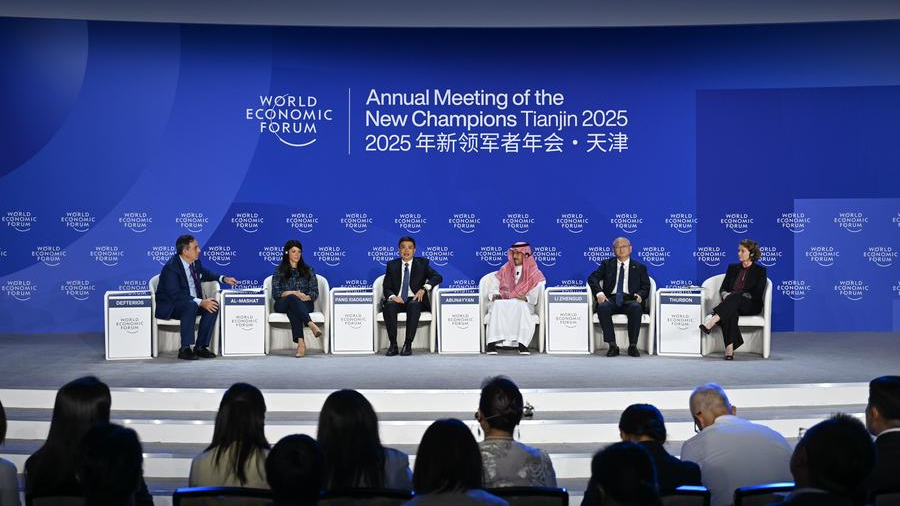
Guests attend the parallel session "Checking In on the Energy Transition" during the 2025 Summer Davos Forum at the National Convention and Exhibition Center (Tianjin) in north China's Tianjin Municipality, June 24, 2025. [Photo/Xinhua]
By Matteo Giovannini
As the world grapples with economic uncertainty, rising protectionism and deepening geopolitical divisions, the 2025 Summer Davos Forum, formally known as the 16th Annual Meeting of New Champions of the World Economic Forum, arrives at a moment of pivotal consequence. The event, held in Tianjin from June 24 to 26, brings together over 1,800 global leaders from government, business, academia and civil society across 90 countries. It serves as a vital platform not only for dialogue but for shaping bold ideas to recalibrate the engines of global growth in an era of profound transformation.
Amid global volatility, China's economic trajectory presents a rare combination of resilience, scale and openness. Its consistent advancement of high-quality development and high-level opening-up has made it a reliable stabilizing force in a landscape marked by fragmentation and distrust. As the world's second-largest economy, China is not merely enduring global headwinds but actively reshaping innovation pathways, industrial modernization and cross-border collaboration.
While many economies face slowing growth, inflationary pressures and domestic polarization, China has emerged from the pandemic-era disruptions with a renewed commitment to structural reform. It has continued investing in strategic sectors likely to define competitiveness in the coming decades such as green energy, advanced manufacturing and digital infrastructure. By doing so, China has fortified itself against external shocks and demonstrated a model of long-term thinking that is increasingly rare in today's political economy.
Importantly, China's efforts extend beyond its borders. Through initiatives such as the Belt and Road Initiative, the New International Land-Sea Trade Corridor and the Global Development Initiative, China is contributing public goods and development financing at a time when multilateral institutions are struggling to meet demand. These frameworks are not just about infrastructure but mechanisms for economic integration, resource mobility and knowledge transfer, all of which serve to stabilize and uplift the global economy.
China's vast and diverse market, home to a burgeoning middle class, remains an unmatched magnet for global businesses. With a unique combination of consumption power, digital sophistication and policy continuity, the Chinese market continues to attract global capital, talent and innovation. Multinational corporations are not only expanding their footprint in China but also embedding themselves in local ecosystems through joint ventures, research hubs and innovation partnerships.
The country's dual-circulation strategy, designed to strengthen domestic demand while promoting international engagement, further amplifies this dynamic. It reflects a vision where China is both a self-sufficient economic engine and a globally integrated participant. In this context, foreign companies are not merely spectators but active stakeholders in China's transformation story, co-investing in the country's shift toward sustainable, inclusive and high-tech growth.
China plays a crucial role in optimizing and reshaping global industrial chains in an age of supply chain fragmentation and re-nationalization trends. Far from being passive in the face of "de-risking" narratives, Chinese enterprises are upgrading their roles, passing from low-end assembly to high-value research and development and design. In doing so, they create new standards, platforms and production networks that integrate efficiency, resilience and digital innovation.
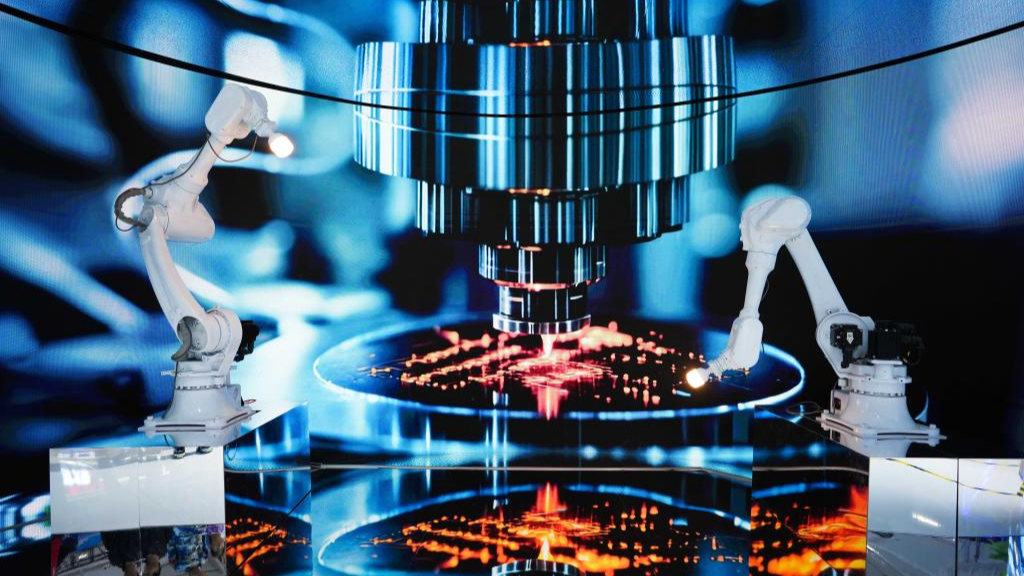
Robotic arms are displayed during the ninth China-South Asia Expo in Kunming, southwest China's Yunnan Province, June 22, 2025. [Photo/Xinhua]
For global firms, this presents both a challenge and an opportunity. The challenge lies in adapting to a more complex geopolitical environment. In contrast, the opportunity lies in co-creating industrial solutions with Chinese partners who bring not just scale, but also speed and ingenuity. Initiatives in sectors such as electric vehicles, semiconductors, biotech and artificial intelligence (AI) illustrate how collaboration can yield mutual benefit when built on trust and complementarity.
Moreover, China's sustained investment in interconnectivity, from ports and railways to 5G networks and data infrastructure, is laying the foundation for a next-generation supply chain model that is smarter, greener and more agile. This is not just a boon for China, but a global asset in a time of fragmented production and uncertain logistics.
This year's gathering in Tianjin is more than a conference, as it reflects China's evolving role in the international community. It underscores the idea that entrepreneurship is not just about profit, but about responsibility to people, the planet and future generations. By convening diverse voices under one roof, the forum becomes a laboratory for ideas that can transcend national interests and contribute to shared progress.
This year's theme, "Entrepreneurship for a New Era," is especially apt. It suggests that the path forward lies not in returning to old paradigms, but in embracing innovation, inclusion and cooperation. Whether it's climate tech, AI ethics, or health security, the solutions to our biggest challenges require entrepreneurial spirit not only from startups, but from states, institutions and global leaders.
As Tianjin hosts the Summer Davos Forum, the world would do well to pay attention not only to what China is saying but also to what it is doing. In a time of global uncertainty, China contributes more than just economic output. It provides stability, a clear vision and a willingness to lead.
Matteo Giovannini, a special commentator on current affairs for CGTN, is a finance professional at the Industrial and Commercial Bank of China, a non-resident associate fellow at the Center for China and Globalization, and a member of the Global Young Leaders Dialogue.