中文
中文
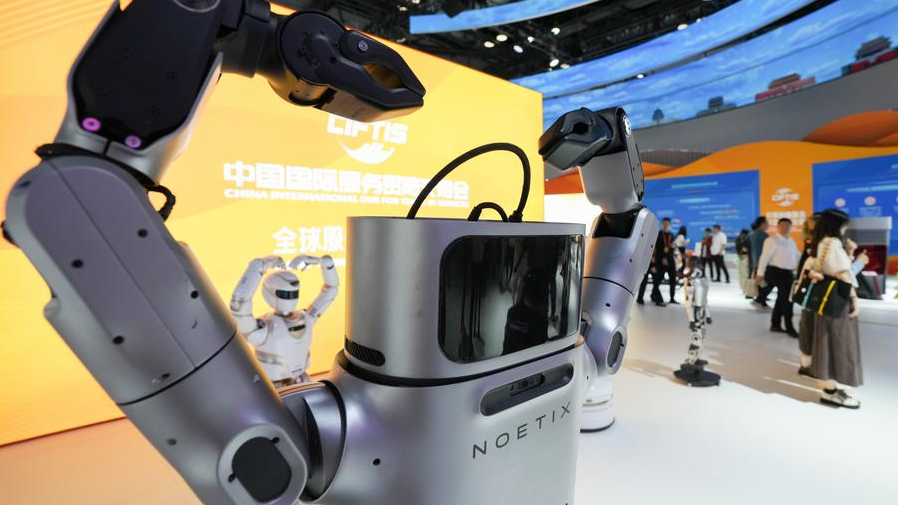
A humanoid makes a gesture to indicate the heart, or love, during the 2024 China International Fair for Trade in Services in Beijing, China, September 13, 2024. [Photo/Xinhua]
By Shi Jiao
The latest meeting of the Communist Party of China's Central Committee Political Bureau on July 30 reviewed the recent economic progress and laid out the roadmap for the country's economic future. It signals a pivotal shift toward domestic demand, particularly the services industry, as global trade tensions and demographic pressures force a recalibration of the world's second-largest economy.
The meeting carried added weight as 2025 marks the final year of China's 14th Five-Year Plan (2021-2025). It also offered early clues about the 15th Five-Year Plan (2026–2030), which will aim to solidify China's transition from an export-driven "world factory" to a more balanced, innovation-led economy. Among its broad policy priorities, one theme stands out: the drive to unleash a consumption boom centered on services.
Since the reform and opening up in 1978, China's economic ascent has been fueled by deep integration into global supply chains, especially after its entry into the World Trade Organization in 2001. No major economy has been more reliant on trade; at its peak, the sum of imports and exports accounted for over 64 percent of GDP. But that model now faces unprecedented strain.
Rising geopolitical frictions, from U.S. tech sanctions to European "de-risking" measures, have exposed the vulnerabilities of China's manufacturing-heavy trade surplus. The fragmentation of global supply chains due to political mandates rather than market forces has disrupted the free flow of goods, capital and knowledge that once defined the era of hyper-globalization.
History shows that vibrant international trade is the bedrock of global peace and prosperity. Its essence lies in specialization and exchange, which makes open markets especially vital for smaller economies that cannot efficiently produce everything domestically.
China is uniquely positioned to weather deglobalization. It remains the only country with all industrial categories under the UN's classification system and enjoys the cushion of a vast domestic market of 1.4 billion consumers. Also, Beijing remains committed to a deeper and more inclusive form of globalization. Amid the turbulent global environment, it recognizes that it bears a responsibility to sustain global integration, a mission that begins with rebalancing its own economy.
The "dual circulation" strategy, introduced in 2020, reflects this shift. It seeks to reduce reliance on foreign markets by invigorating domestic demand. The rationale is clear: Household consumption accounted for just 40 percent of China's GDP in 2024, far below the 55 to 70 percent typical of advanced economies. Rather than spending, Chinese households channel a large share of their income into savings, contributing to the nation's high saving rate.
Yet a country's net saving and its trade surplus are two sides of the same coin. A trade surplus means China earns more from exports than it spends on imports, effectively accumulating savings in the form of foreign assets. But now the tide is turning: Households are expected to drawdown savings to power consumption.
The question is, what form should this new consumption take? The data reveals a critical imbalance. In 2024, China recorded a $768 billion goods surplus but ran a $229 billion services deficit. This contrast – a persistent surplus in goods and deficit in services – reflects an economy where factories overproduce while service sectors, from healthcare and eldercare to fintech and cloud computing, lag behind. Meeting this surging demand for quality services may well define the next stage of China's growth story.
China's transition to a services-led economy hinges on deep structural reforms, many of which were foreshadowed in the politburo's latest directives. High-end services cannot thrive without key foundations, and the 15th Five-Year Plan is expected to tackle these challenges head-on.

An artificial intelligence-driven bartending system at the Siemens booth in the Advanced Manufacturing Chain exhibition area of the second China International Supply Chain Expo in Beijing, China, November 27, 2024. [Photo/Xinhua]
Boosting household consumption demands higher incomes and robust social safety nets. Demand for premium services – whether private healthcare, fintech, or leisure – emerges only when households feel financially secure. With China's savings rate among the world's highest, policymakers must address the gaps in healthcare and pension that compel families to save excessively instead of spending on essential and quality-of-life services. Recent moves like childcare subsidies and pension reforms for the elderly indicate that such rebalancing has already begun.
Equally crucial is removing barriers to fair competition. Services often entail heavy upfront investments in research and development (R&D) but once done, they can be delivered at low marginal cost. These sectors need integrated and competitive markets to thrive. The politburo's call to create a "unified national market" while curbing "disorderly competition" signals an effort to foster a more conducive environment for service-sector innovation.
Talent and digital infrastructure are no less important. High-value sectors, from artificial intelligence-powered education to precision medicine and green finance, demand skilled labor and advanced connectivity. Expect major investment in science, technology, engineering and mathematics programs and cutting-edge digital infrastructure such as 5G networks, supporting telemedicine, remote learning and cloud-based R&D, along with intensified incentives to attract global talents to China.
Finally, deeper engagement with globalization can raise standards. Pilot programs in free-trade zones, testing cross-border data flows, financial liberalization and expanded foreign ownership in sectors like cloud computing will attract international expertise while maintaining regulatory oversight.
Greater openness serves two purposes: It reassures global investors wary of decoupling, while using foreign know-how to enhance domestic service quality. For multinational firms, these initiatives will offer opportunities to access China's next growth frontier.
Shi Jiao, a special commentator on current affairs for CGTN, is an associate professor at Peking University HSBC Business School and deputy director at the Sargent Institute of Quantitative Economics and Finance.