中文
中文
By Xia Fangting
Assistant Foreign Minister Miao Deyu, speaking at the opening ceremony of a think tank forum in Beijing, highlighted the strategic vision laid out last month by Chinese President Xi Jinping at the fourth ministerial meeting of the China-CELAC (Community of Latin American and Caribbean States) Forum. President Xi announced then the launch of five programs of Solidarity, Development, Civilization, Peace, and People-to-People Connectivity, aimed at further promoting the building of a China-LAC community with a shared future.
Miao said these programs have provided direction for the development of China-LAC relations and injected strong momentum into the cooperation.
"China is committed to working with LAC countries to advance the five programs for a closer China-LAC community with a shared future," Miao said at the seventh China-Latin America and Caribbean Think Tank Forum on June 20.
Claudio Coloma, assistant professor at the University of the Americas in Chile, said China and Latin American and Caribbean (LAC) countries must deepen mutual trust and overcome misunderstandings and biases.
Coloma called for efforts to dispel the so-called "China threat" and move beyond Western narratives to promote stronger economic ties between China and the region.
China has consistently supported multilateralism and global cooperation, especially South-South cooperation, and backed the development of LAC countries, even as the world faces rising unilateralism, protectionism, climate change and regional conflicts, Coloma said.
Coloma highlighted the remarkable growth in the trade between China and LAC countries, which surged to $518 billion in 2024. China is now the grouping's second-largest trading partner and the top trading partner for countries like Brazil, Chile and Peru. He also emphasized China's growing role as an investor in the region's infrastructure and its extensive medical aid to LAC countries.
Zhou Zhiwei, director of the International Relations Research Office at the Institute of Latin American Studies, Chinese Academy of Social Sciences, underscored the shared values and aspirations of China and LAC countries.
"China and LAC countries have traditionally valued their independence and autonomy. Both sides see each other as development opportunities and share a mission to reform the global governance system. This consensus forms a basis and direction for China-LAC cooperation," Zhou said.
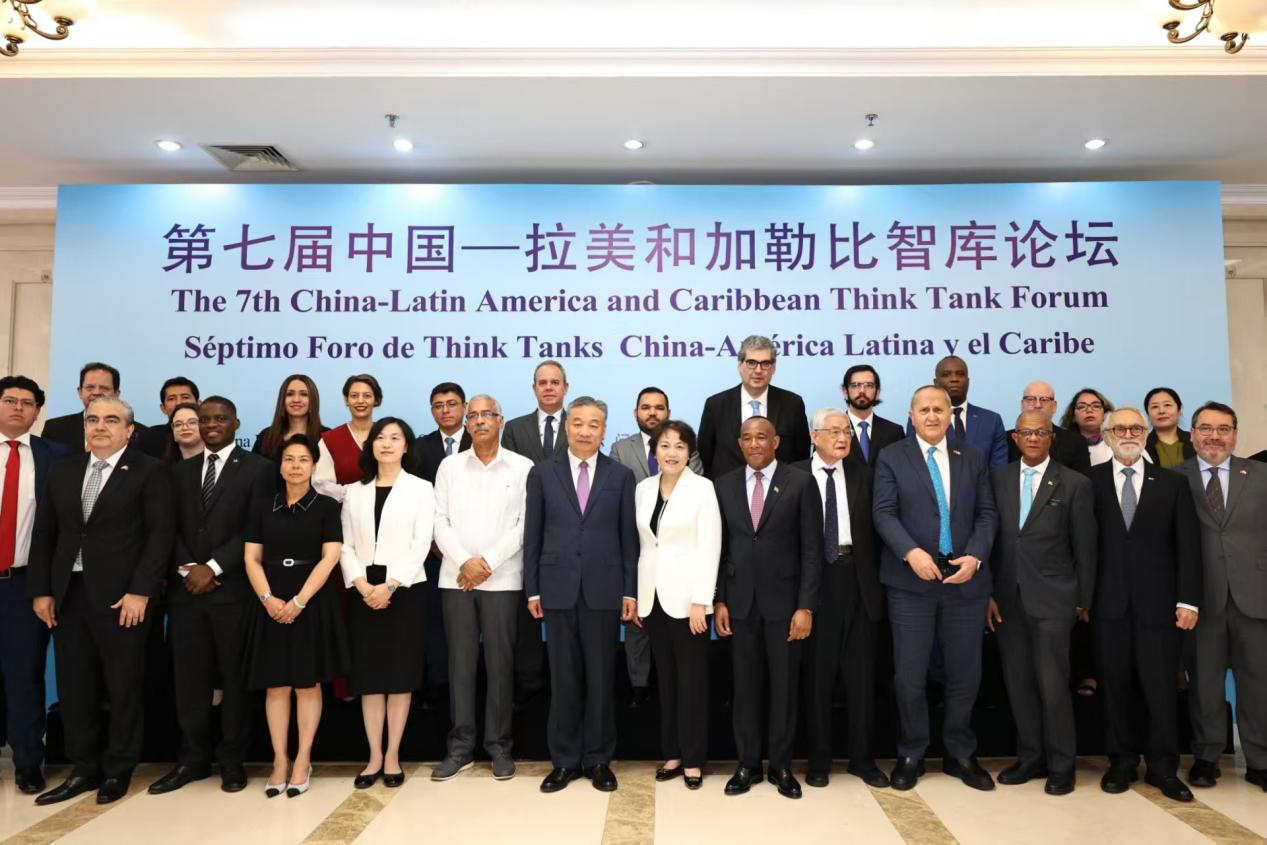
Participants pose for a group photo during the seventh China-Latin America and Caribbean Think Tank Forum on June 20, 2025. [Photo courtesy of the China Institute of International Studies]
Hosted by the China Institute of International Studies, the forum brought together more than 120 participants, including ambassadors from Mexico, Honduras, Chile and other countries, as well as government officials, scholars and media representatives.
The discussions focused on topics such as greater BRICS cooperation, the Global South, and building a China-LAC community with a shared future.