中文
中文
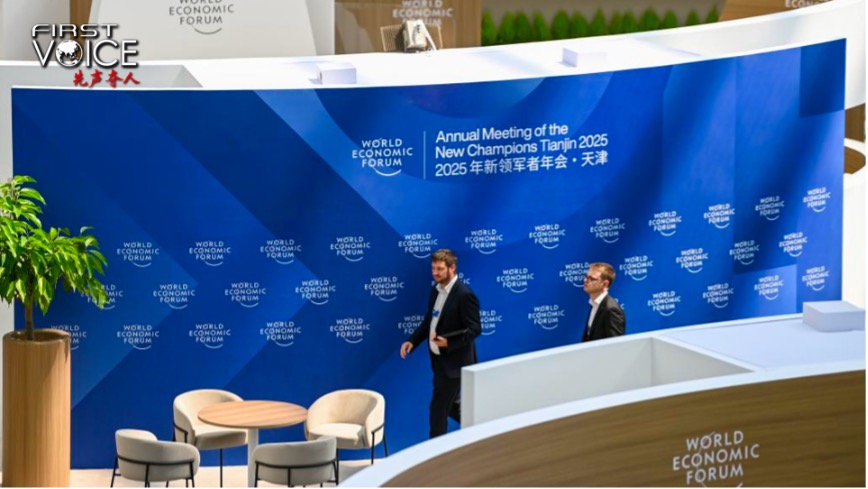
The venue for the 2025 Summer Davos, in north China's Tianjin Municipality. [Photo/Xinhua]
Editor's note: CGTN's First Voice provides instant commentary on breaking stories. The column clarifies emerging issues and better defines the news agenda, offering a Chinese perspective on the latest global events.
"Over the years, no matter how the international environment has changed, China's economy has consistently maintained a good momentum," Chinese Premier Li Qiang said at the opening plenary of the 16th Annual Meeting of the New Champions, also known as the Summer Davos, in China's Tianjin.
The remarks were made at a time when the world is struggling to find its way out of trade tensions, tariff disputes, and geopolitical uncertainties.
The resilience in the Chinese economy is no accident; it is the result of a multifaceted approach combining strategic governmental policies, a robust industrial base and strong domestic demand.
As the world's manufacturing powerhouse, China benefits from extensive supply chains, technological innovation clusters, and a massive domestic market. This industrial strength underpins export growth and economic stability, even as global trade faces uncertainties.
China has pledged to stabilize the manufacturing sector's proportion of GDP in its 14th Five-Year Plan, which concludes this year. The sector has remained steady throughout this period, making up around 27 percent of the country's total GDP and approximately 30 percent of the global manufacturing industry.
This contrasts sharply with other leading economies – the U.S.'s manufacturing share stands at around 11 percent, Germany's at 18 percent, and Japan's between 19 and 20 percent, according to the World Bank.
Moreover, China is not just maintaining traditional manufacturing. It is rapidly advancing in high-tech and green industries.
For instance, the intelligent Unmanned Aerial Vehicle (UAV) manufacturing sector saw its added value surge by 74.2 percent in April alone. Meanwhile, production of new energy vehicles grew by 38.9 percent in the same month, showcasing the country's commitment to innovative manufacturing.
China is willing to share its original technologies and innovative scenarios with the world, Li said on Wednesday, adding that China will continue to deepen its integration and connectivity with the world market and strengthen industrial collaboration with various countries.
China's industrial base not only drives export growth but also supports domestic consumption through job creation and income generation. Against protectionist headwinds, Chinese policymakers, fully aware of the vulnerabilities of export-led growth, have also been steering the economy toward a more consumption-driven model.
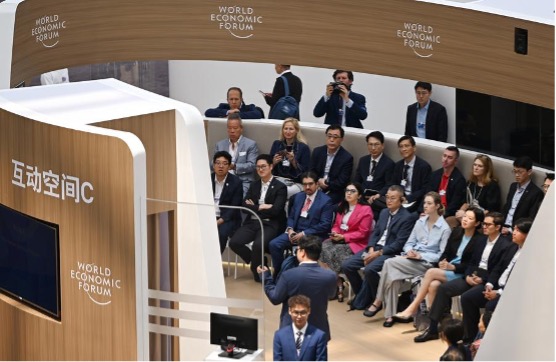
Guests at the 2025 Summer Davos Forum at the National Convention and Exhibition Center (Tianjin) in north China's Tianjin Municipality, June 24, 2025. [Photo/Xinhua]
Li noted on Wednesday that China is striving to develop itself into a super-sized consumption powerhouse on the solid foundation of a manufacturing powerhouse.
"The combination of policies in both supply and demand has successfully stimulated consumer sentiment, with notable impacts on capital markets and retail growth momentum," according to a Deloitte report in April. "This will lay the groundwork for sustained optimism going forward."
True, the Chinese economy still faces challenges, including trade tensions and fluctuations in foreign investments. However, China's comprehensive policy toolkit and economic fundamentals provide a substantial buffer against these risks. The government's willingness to adapt policies as needed and the country's diversified structure help mitigate potential shocks.
China's growth is not for its own sake. Li pledged at the meeting that the country is willing to do whatever it takes to help tackle the difficulties and challenges facing the global economy.
As the world is experiencing volatile declines of cross-border investment and growing risks of fragmented production and supply chains, Chinese government will continue to foster a first-class business environment that is market-oriented, law-based and internationalized, and always keep the doors wide open and warmly welcome businesses from all countries to invest and deepen their roots in China, Li said.
Li's call for countries to avoid politicizing trade and to work collaboratively reflects China's commitment to globalization and multilateralism, positioning itself as a responsible global economic leader.
Amid global uncertainties, China's economy is not just surviving – it is evolving and thriving, setting the stage for continued influence in the years to come.